CASE FILESUBJECT: ONE (1) RAILWAYSTATUS: COMING SOONTHREAT LEVEL: CAFFEINATED
Exhibit C · coming soon · Windows PC
— a transport management sandbox for Windows PC, coming soon
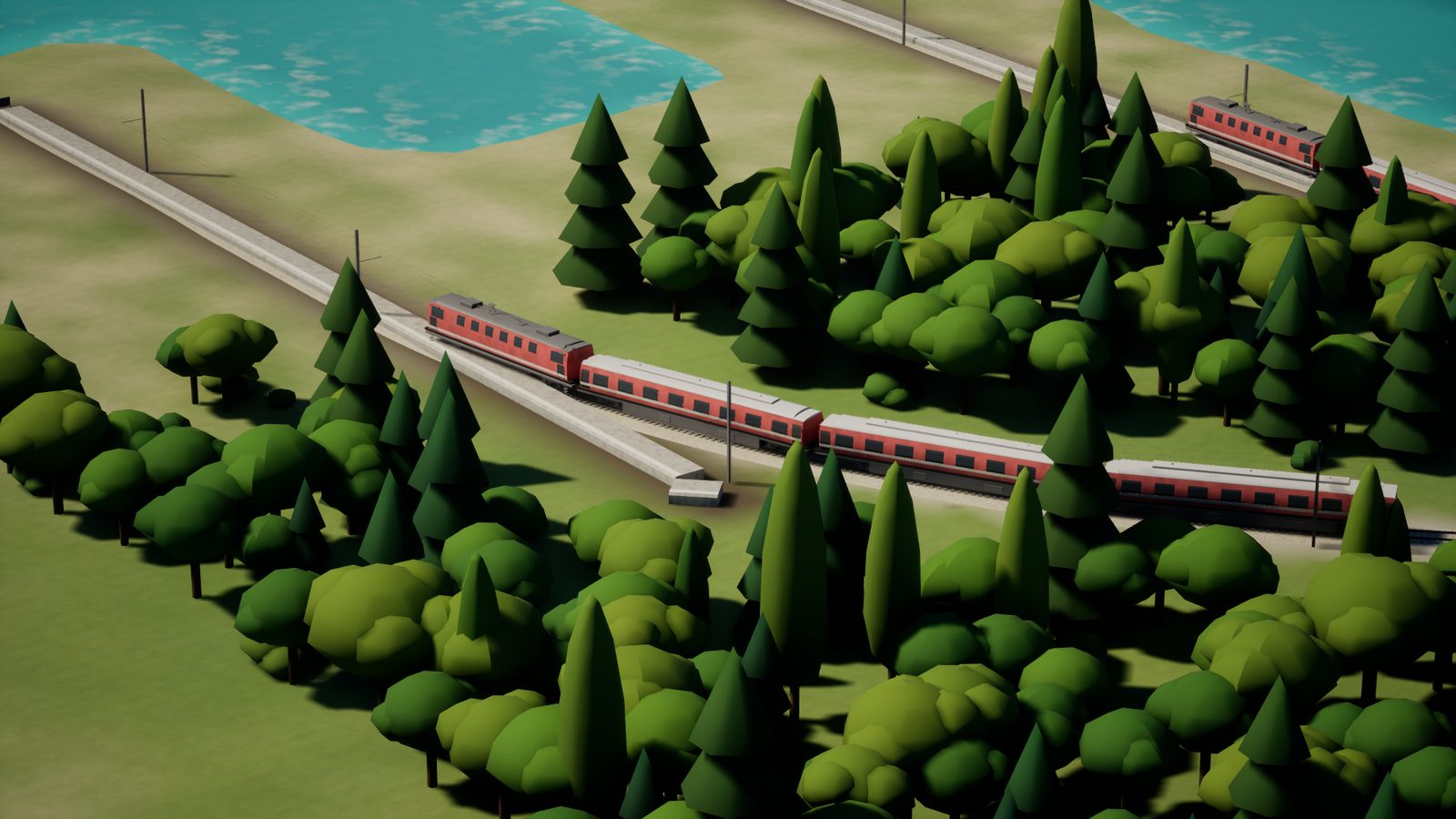
NewCaptains is a transport management sandbox for Windows PCs. Lay rail, road, canal and airport networks, buy trains, buses, ships and aircraft, and haul coal, goods, food and passengers between towns and industries as the decades change. It keeps the classic build-haul-earn loop and adds curved track with speed limits, free bridges and tunnels, level crossings that bite, and a day and night cycle. In development; no release date yet.
Every great railway begins with a modest loan and a regrettable level crossing.
Coming soon. The track is laid; the schedule is aspirational.
DeparturesPlatform 1as of 3 Oct 2026
NewCaptainsearliest public build · likely case
Jan 2027
Window
Nov 2026 – Apr 2027 (fast – slow)
Countdown
106days to the likely ETA
Status
Estimate, not a promise
No store page yet. This is arithmetic on stated assumptions. Show the working.
NewCaptains is a transport management sandbox. You lay track and roads between towns and industries, buy vehicles at a depot, give them orders, and get paid for whatever arrives. The calendar moves through five eras, and the vehicles on offer change with it.
Lay track and roads
Join a mine to a power station, a forest to a town. Drag a curve and see its cost and its safe speed before you commit.
Buy and run vehicles
Buy a locomotive and wagons at a depot, write their orders and timetable, and send them out.
Haul cargo as the decades change
Coal, wood, goods, food, water and passengers move between towns and industries while the years go by.
In the box todaycounted 3 Oct 2026
17vehicle models
6cargos
9industry types
5eras
15interface languages
16 kmsquare default map
The 17 models are 5 locomotives, 5 wagons, 3 road vehicles, 2 ships and 2 aircraft. The industry count includes towns. All 15 languages carry the same set of text keys; checking how each one looks on screen is still to do. This is a young build, so the content is thin and we would rather say so.
FILE 02/ what is different
What is different, and how sure we are
The genre has rules everyone knows. Here is where this one bends them, graded by how much of it you could click on today. Jokes never outrank grades.
ARuns today
Seen working in the real game.
BBuilt, not shown
Works in the simulation, but not yet in the game you can click.
CDrawn, not built
Designed on paper. No code yet.
Tally: 6 run today · 2 built, not shown · 3 drawn, not built. The evidence-grade legend is the fine print; the fine print is the point.
01ARuns today
Curved track with a live speed limit
You
Drag a curve and a graph shows its cost and the fastest safe speed before you commit. Tighter curves cost more.
Different
Speed follows the curve radius and the track class, not a flat rule per piece. Standard track manages 32 km/h at 128 m and 46 km/h at 256 m.
Limit
Slice one only: one arc per drag, radii 16 to 256 m. Road curves, easing curves and 45° arcs are not built.
02ARuns today
Switching, not just stations
You
Serve an industry from your own siding or “hold”, cut cars away, shove them in. Keep stations for the big terminals.
Different
Cars and switching, not just a station parked next to the factory.
Limit
Holds and orders run today. The shove, runaround and wye visuals are not yet part of the automatic checks.
03ARuns today
Level crossings that bite; breakdowns that get rescued
You
Trains never stop for a crossing. An unprotected or broken one destroys a vehicle, fines you and makes the news. Broken locomotives limp to a depot, and tow trucks and puller locos rescue them.
Different
Consequences instead of waiting.
Limit
Proven in a dedicated test pass, not yet in the default checks. Road vehicles do not have service intervals yet.
04ARuns today
Free bridges and tunnels over anything
You
Span a river, a road or a rival’s line, whoever owns the track below. No permission and no fee; clearance rules refuse bad spans.
Different
No permits, no tolls and no ownership fights over a crossing.
05ARuns today
Day and night, seasons, a first-route guide and undo
You
Lit locomotives and aircraft, a sun and a moon, and seasons. A nine-step first-route guide ends with a one-time celebration when your first train arrives. Ctrl+Z undoes track and road builds.
Different
You set the length of a day, from 30 minutes to 4 hours, or follow your own clock.
06ARuns today
A scale you can state
You
Cells are 16 m. Distances are shown in “game km”, and one game km is deliberately 256 m. The default map is 16 km square.
Different
Curve radii, speeds and lengths are in real units, so a 128 m curve is a 128 m curve.
07BBuilt, not shown
Towns that grow building by building
You
Towns extend their own roads and add or replace single buildings, so a town’s size follows the land rather than a fixed circle.
Different
Forty building types, placed one at a time.
Limit
Works in the simulation; not yet proven in the game build. Town roads and per-building cargo are not built.
08BBuilt, not shown
Rivals that follow the same rules as you
You
Rival companies build and trade only through the commands you use. No scripted opponents, no cheats.
Different
No hidden advantages, by design.
Limit
Fifty-game-year balance runs with four rivals come out clean, but rivals are not yet shown in the game build. A few rival routes freeze on some maps; that is on the fix list.
09CDrawn, not built
Hills that matter
You
A heavy train stalls on a steep grade. A helper engine can couple on, or you split the load and “double the hill”.
Different
Grade and tonnage genuinely limit what a train can do.
Limit
Drawn, not built. Today the simulation only applies gravity per wagon on slopes.
10CDrawn, not built
Click, stretch, lay
You
Click, drag and stretch a route with natural curves anywhere. The sharper the curve, the slower the train.
Different
Replaces fixed-arc dragging with free paths.
Limit
Drawn, not built. It is the studio’s top priority.
11CDrawn, not built
Customers, yards and real dispatch
You
Customers get their own spurs, and you order cars by count instead of buying wagons. Yards assemble trains, with an optional hump. Dispatch grows from controlled locations to centralised control to automatic train control.
Different
Freight as persistent cars and customers.
Limit
Drawn on paper only. No code yet.
FILE 03/ photographic exhibits
Seventeen real captures, in two flavours
Real captures from the build’s own test runs. Nothing here is concept art. Some of the interface shows a “Proof world” badge, because these runs come from the test harness. Click one to enlarge it.
In-gameCaptured from the running game client, interface visible.
ShowcaseRendered by the test harness in a small test world, no interface.
Day 3 vs day 18 the same project, fifteen days apart
The first commit was on 16 September 2026, so 18 September is day 3 and 3 October is day 18.
Day 4 vs day 18 the same test shot, then and now
FILE 04/ how it works
How it works, with the covers off
Two halves that never reach into each other, one rule for curves, and a clock. Then the instruments: what we measured, when, and what it does not mean.
Two halves, one rule grade A · built and running
Fig. 1 · the two halves
The client only draws. It never changes the world. A click becomes a command; the simulation checks it inside the tick and may refuse it.
The simulation never waits for pictures. It runs on its own thread at a fixed 30 ticks a second, so a slow frame cannot stall the world.
Integers only. Money is whole cents and ratios are fixed-point, so the same seed and the same commands give the same game, tick for tick.
A state hash every tick is how we notice, to the tick, when something stops being deterministic.
The curve rule grade A · slice one
The curve you drag is rounded to one of eight radii: 16, 32, 48, 64, 96, 128, 192 or 256 m. Max safe speed is the lower of the track class ceiling and a limit that grows with the square root of the radius.
Maximum safe speed by curve radius, standard and high-speed track
Curve radius
Standard track
High-speed track
R4 4 cells · 64 m
23 km/h
38 km/h
R8 8 cells · 128 m
32 km/h
54 km/h
R16 16 cells · 256 m
46 km/h
77 km/h
Rule: max safe speed = the lower of (track class ceiling, √(radius × sideways acceleration)). Halve the radius and the speed falls by about 30 per cent. Tighter curves also cost more to lay, in proportion to (R + 2) ÷ R per cell step.
The clock grade A
30simulation ticks per second
74 ticksmake one game day: about 2.5 seconds at 1×
15 minmake one game year at 1× (27,010 ticks). Speeds are pause, 1×, 2× and 4×.
The workings, in the game eight captures
Interface and instruments from the running build. The last one is the simulation’s own debug viewer, which is not the game and does not pretend to be.
On paper only grade C · drawn, not built
Fig. 2 · planned, not built
CDrawn, not built
A trip would start only if the destination has reserved slots. Otherwise the train is staged with a stated reason, and you get four fixes:
Expand the yard.
Add storage.
Reduce the allocation.
Use another yard.
None of this is in the game today. It is on paper, with a design written and nothing coded.
Telemetry as of 3 Oct 2026
Seven readings, each with where it comes from. The benchmark line is a benchmark of the simulation alone; it is not what the game window shows.
Telemetry readings as of 3 October 2026
Reading
Value
What it is
Comes from
Automated tests
2,732 passing
The full automated suite. About 30 timing-sensitive tests run separately.
Automated test run
In-game checks
59 of 59 passing
Scripted checks that run inside the real game client, latest run.
Game-client check run
Frame rate
81.6 fps average
At 1080p on one desktop GPU in a development build. The GPU was shared with other work, so treat it as a rough guide, not a spec.
Game-client check run
Simulation benchmark
6.25 ms per tick
Average for 1,000 timetabled trains, 500 road vehicles, 150 ships, 100 aircraft and 5 rival companies, against a 33.3 ms budget. A benchmark, not the game window.
Headless benchmark
Balance run
50 game years, 0 findings
Four rival companies played fifty game years with no deadlocks and no insolvency.
Headless balance run
Code size
~285,000 + ~165,000 lines
About 285,000 lines of product code plus about 165,000 lines of tests.
Line count
Age
18 days
Since the first commit on 16 September 2026.
The calendar
FILE 05/ recreation room
The passing siding
A TOY, NOT THE GAME
This is not NewCaptains. It is a small toy for passing the time on this page: two trains, one single track and one passing siding. Throw the switch before the red train reaches the points, so it takes the siding and the blue train can get by.
A TOY · single track · one siding · toy numbers only
Route one train into the passing loop to prevent deadlock!
The signal lamps are for show: only the switch matters. Any money in this toy is pretend. The real game does not work like this, and nothing here is a feature.
FILE 06/ the pinboard
Concept art
Concept — not in the gamedirection, not a build
The viaducts, the glass-and-light interface and the modular stations pictured here are goals, not features. Nothing on this board runs. The real interface looks different, and the lettering inside the mock-ups is placeholder.
FILE 07/ goals and pillars
What we are trying to build
Seven pillars, and a list of things this will never be. Where a pillar is only partly real, it says so.
Keep the classic loop; add depth only where it pays
Build, haul, earn stays the heart. New depth, such as switching, goes in only where it pays for the company.
Status: switching holds and curved track run today.
Fun is the test
Every feature faces one question: would a veteran of the genre smile more?
Natural track
Click, stretch and lay track with natural curves anywhere. The sharper the curve, the slower the train.
Status: curve speed limits run today, one arc per drag. Free-form laying is drawn, not built.
Hills matter
Trains stall on steep grades under heavy loads, and a helper engine can couple on.
Status: drawn, not built.
Freedom to run a railroad like the real thing
Locomotives, cars, customers and yards used the way a railway uses them.
Status: drawn, not built.
The world is the dashboard
Data should live in the world. You read the network by watching it work, and it should be as satisfying to watch as to run.
Same seed, same game
The simulation is deterministic: same seed, same commands, same result.
Status: checked every tick by a state hash.
This will never be
A city builder. No zoning, no utilities, no citizen simulation.
A combat or survival game.
A game with premium currencies or pay-to-win.
A mobile game.
FILE 08/ progress
Eighteen days, in plain words
What happened, when. Everything below has been built; how much of it you could click on is what the grades above are for.
16 Sep
First commit. The simulation kernel runs 1,000 trains. Stations, orders, payment, signals and timetables follow the same day.
17–18 Sep
World generation, towns, water, air and vehicles by era; a fifty-year balance run; a first debug viewer.
19 Sep
The Unreal Engine client boots. First box on rails.
20–22 Sep
Terrain, water and the first vehicle models.
21 Sep
Buy a train from a depot. Save and load.
23–27 Sep
Switching, labour and inflation (on the simulation side), day and night, curved track, bridges, the first-route guide and town actions.
28 Sep
A quality programme starts with 94 work orders. It has since grown to 120.
29 Sep – 3 Oct
New-game options, undo, towns made of buildings, a front end, level crossings, free bridges, and an independent review of the whole project.
The status board
as of 3 Oct 2026 · 120 tracked work orders · 33% closed
40closed
1running
20ready to start
58waiting on something else
1superseded
Be fair to the number. Only 22 of the 40 closed items are things a player can see. The rest is plumbing, libraries and design.
FILE 09/ the schedule
The schedule, arithmetic showing
A date with no working is a wish. This is the sum, the assumptions behind it, and the ways it goes wrong. It is arithmetic on stated assumptions, not a promise, and there is no store page yet.
ARITHMETIC, NOT A PROMISE
The sum
The open list is the planned work still to do. “Closed per day” is how fast we finish items; “new per day” is how fast we add them. What is left each day is the net burn-down. Divide the open list by it and you get the days until the planned work is done. Then add a ship gate, in weeks, for everything that is not on the list.
days until the planned work is done = open work orders ÷ (closed per day − new per day)earliest public build = the day that work is done + the ship gate (weeks)
The ship gate covers store review (the plan allows four to six weeks), a closed playtest, balance, and an art pass. Right now there are 79 open work orders.
What we observed
40 of 120tracked work orders closed in 6 days, which is 6.7 a day.
94 → 121items on the list over the same week, so about 4.5 new items a day arrived. (One of the 121 is a standing lane, not a work order.)
So the net burn-down is slower than the closure rate. Closing 6.7 a day while adding 4.5 a day leaves far less than 6.7 a day of real progress. That is the whole reason for the three scenarios below.
Three scenarios
Fast
Nov 2026
Observed closure rate (6.7 a day) and a quarter of the observed rate of new work.
Ship gate 6 weeks.
Likely
Jan 2027
Two-thirds of the observed closure, because what remains is the heavy kind that touches the simulation core, and half the observed rate of new work.
Ship gate 10 weeks.
Slow
Apr 2027
Closure limited to the rate core changes have actually landed (3.2 a day), and half the observed rate of new work.
Ship gate 16 weeks: adds a handheld hardware check, a store festival cycle, name clearance and credential slack.
The three scenarios, side by side
Measure
Fast
Likely
Slow
Closed per day
6.7
4.4
3.2
New work per day
1.1
2.3
2.3
Net per day
5.5
2.2
1.0
Days to finish the list
15
36
84
Work done on
18 Oct 2026
8 Nov 2026
26 Dec 2026
Ship gate (weeks)
6
10
16
EARLIEST PUBLIC BUILD
Rates are rounded to one decimal; days are computed from the unrounded rates, so a hand subtraction on the rounded figures can differ a little. Dates run from 3 Oct 2026. The headline is the likely case; the window runs from fast to slow.
What would move it
Scope growth. The list grew faster than it shrank this week. If that continues, every date slides.
One change at a time. Only one change to the simulation core can be merged at a time, and most of what is left is that kind.
One graphics test slot. Only one copy of the game engine can be tested at once on the one development machine.
Store review. The plan allows four to six weeks, and it is outside our hands.
Name clearance. The name has to be cleared before a real launch, and clearance takes as long as it takes.
The art pass. The vehicles still read as programmer art with good silhouettes, and that is a job in itself.
Plainly: this is arithmetic on stated assumptions, not a promise. There is no store page, no price and no release date. If the list keeps growing as fast as it did this week, the sum gets worse, and this page will say so.
Station announcement: the Early Access service is delayed by an unspecified amount of scope.
FILE 10/ questions
Questions at the information desk
Is it out?
No. There is no release date, no store page and no price. The only date here is the estimate in the schedule, with its arithmetic.
Which platforms?
Windows PC first. Nothing else is promised.
Will it have multiplayer?
Not promised. The determinism and a network test harness exist, but there is no lobby and no network transport, and nobody should plan a game night around it.
Will there be a demo?
Unknown. Nothing has been decided, and we would rather say so than guess.
How is it different from Synapse Grid?
Almost completely. Synapse Grid is a fast light-cycle combat racer built around reflexes. NewCaptains is a slow-burn transport sandbox built around planning, timetables and consequences. Same studio, same one person.